
- News
Lin Xiao, recipient of the 2026–2027 BnF/FAn Fellowship
The PSL FAn Research Programme welcomes Lin Xiao, a linguist specializing in Sinitic languages and the history of Mandarin, whose work bridges philology, linguistic typology, and the digital humanities.
Introduction to Lin Xiao, 2026–2027 BnF/FAn Fellow

A French linguist born in Beijing, Lin Xiao studies Chinese languages and civilization—from grammar to linguistic anthropology—from a typological, diachronic, and comparative perspective that combines traditional philology with natural language processing (NLP) applied to documentation and field corpora.
Her research focuses on: (1) the iconicity of Chinese syntax (her doctoral dissertation); (2) the typology of differential markings in Sinoitic languages, both synchronically and diachronically (her unpublished HDR thesis); (3) the history of Mandarin: diversity, koineization, dissemination, and teaching (principal investigator of ANR-24-AERC-0007-01; associate researcher at the Bibliothèque nationale de France).
She holds a Ph.D. from Sorbonne University and an HDR (Habilitation à diriger des recherches) from the École normale supérieure - PSL, and was awarded the “Jean-Charles Perrot” Linguistics Prize by the Académie des inscriptions et belles-lettres in 2020.
Introduction to the HydroKoine Project: How Did the Grand Canal of China Shape the Mandarin Language?
“Hydrographic Maps of China (17th–19th Centuries) and the History of Mandarin: Inventory, Linguistic Isoglosses, and Interactive ArcGIS Online Maps”
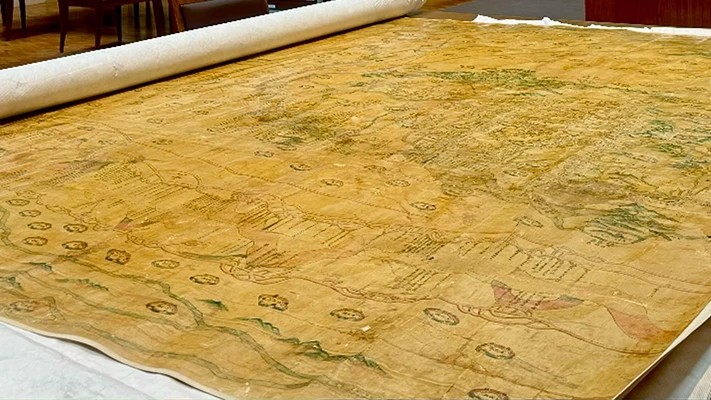
Mandarin is the world’s most widely spoken language in terms of the number of native speakers, with nearly one billion speakers in mainland China, Taiwan, Southeast Asia, and among diaspora communities. Yet its development and internal diversity remain poorly understood. The HydroKoine project approaches Mandarin as a koine, a concept borrowed from the study of Hellenistic Greek: a common language that emerged from contact between regional varieties, long before any official standardization took place.The project draws on the hydrographic maps of China held by the Maps and Plans Department of the BnF, which it will catalog. The project’s hypothesis is that waterways served as corridors of linguistic convergence, foremost among which is the Grand Canal. Stretching 1,776 km between Beijing and Hangzhou, the Grand Canal is the world’s longest man-made waterway; in 1820, it provided for the livelihoods of more than 126 million people, which was about 12% of the world’s population at the time, thanks to the grain-tribute transportation system. From its reactivation in 1415 until the abolition of the grain-tribute system in 1901, it is believed to have fostered prolonged contact along its route between the dialect subgroups of Mandarin: Jiāng-Huái (which includes Nanjing), Jì-Lǔ, Jiāo-Liáo, and Beijing. This contact is thought to have led to directed convergence, or koineization, in a sociolinguistic environment marked by competition between Beijing and Nanjing for linguistic prestige.
To test this hypothesis, the project will overlay Mandarin isoglosses (phonology, lexicon, syntax) onto georeferenced hydrographic networks in a GIS. It will then generate an interactive online map. In particular, it will examine whether the decline of the canal in the 19th century coincided with a decline in the prestige of Nanjing Mandarin.